Why Motorized Screens Fail | OneTrack | Yoders Up North
Why Most Motorized Screens Fail in Five Years — and OneTrack Doesn't
Almost everyone who's nervous about motorized screens is nervous for the same reason: they've seen a set that failed.
Maybe it was a neighbor's. Worked beautifully for two summers, then started snagging on the way down. The zipper edge gapped, and the bugs the screen was supposed to stop started finding their way in anyway. A windy night pulled it half out of its track. The motor began to grind, then strain, then one day it just stopped — and the repair call cost more than anyone expected, because the technician had to drive in from three hours away. By year five or six the whole thing was more trouble than it was worth, and it became the cautionary tale people repeat: "we looked at motorized screens, but they don't last."
Here's the thing worth understanding: that screen didn't fail by bad luck. It failed for one of a handful of specific, predictable engineering reasons — the same reasons most lower-tier retractable screens fail within five to ten years. And once you know what those failure points are, you can see exactly why a properly engineered system avoids them.
This is the fourth installment of Built for the North. It's the autopsy: the four ways motorized screens die, and how the Fenetex OneTrack system we install is engineered against each one. If you read one piece before deciding whether screens are worth it, this is the one.
Quick Answer
Why do motorized screens fail, and what makes OneTrack different?
Most lower-tier motorized retractable screens fail within five to ten years at four predictable points: the zipper or cable that retains the screen edge snags and gaps; the motor burns out from lifting the screen's full weight on every cycle; the screen binds or gaps as the structure settles and shifts over time; and a light weight bar lets wind flex, billow, and tear the screen loose. The Fenetex OneTrack system is engineered against all four. Its Lock Tight welded keder edge has no zippers to fail and keeps the screen locked in its track. Its patented Quiet Spring spring-balanced motor only starts and stops the screen instead of lifting its full weight, which the manufacturer credits with 99% fewer service calls. Its Self-Adjusting Track compensates automatically for structural settling. And its weight bar — the heaviest in the industry, with reinforced corners — holds the screen flat and stable in wind, rated to 100 mph. The welded keder carries a lifetime warranty. That engineering is the entire reason YODERSUPNORTH installs OneTrack and nothing cheaper.
Failure Mode One: The Zipper at the Edge
The single most common failure point in motorized screens is how the screen's edge is held into the track. Most lower-tier systems use a zipper or a cable sewn along the edge of the mesh. It works at first. But a zipper is a lot of tiny moving parts living outdoors in grit, pollen, and freeze-thaw, and it does what zippers do: it snags, it separates, it wears. Once the edge stops sealing cleanly, two things happen at once — the gap lets insects back in (defeating the entire purpose), and the screen is no longer firmly captured, so a gust can pull it out of its track.
OneTrack doesn't use a zipper. It uses what's called a keder edge — a technique borrowed from sailboat rigging. A continuous polymer cord is bonded into the edge of the screen, and that cord rides captured inside the aluminum track. Critically, the screen edge isn't sewn or glued to the keder; it's welded to it, so the keder and the screen become a single solid piece with no stitching, glue, or zipper teeth that can fail. That fused edge is held inside the track along its entire length, which is why the system is designed to never come out of its track even under wind load.
This is the failure mode OneTrack most directly engineered out, and the company's confidence in it shows up in the warranty: the welded keder attachment is backed by a lifetime warranty. You don't put a lifetime warranty on the exact part your competitors' products fail at unless you've genuinely solved it.
Failure Mode Two: The Overworked Motor
A motorized screen is heavier than it looks, and in a basic system the motor lifts that entire weight every single time the screen goes up. Do that several times a day for a few years and the motor is under constant strain — it gets louder, it grinds, and eventually it burns out. The motor is also the most expensive single component to replace, so its failure is often the moment a homeowner decides the whole system isn't worth maintaining.
OneTrack's answer is its patented Quiet Spring technology, and the easiest way to understand it is the comparison the engineers themselves use: shock absorbers in a car. A spring carries the screen's weight, so the motor isn't fighting gravity on every cycle — its only job is to start and stop the screen. That's a fundamentally lighter duty than lifting, which is why the system runs nearly silently and why the manufacturer credits the design with 99% fewer service calls over the system's operating life. A motor that isn't straining is a motor that doesn't burn out.
There's a comfort benefit too, which matters more than it sounds. Cheaper systems are noisy — a grinding, clanging deployment that announces itself across a quiet evening. A spring-balanced screen deploys in near silence. On a still Northern Michigan night, that difference is the whole point of being outside.
Failure Mode Three: The Structure That Moved
This is the failure nobody anticipates, and it's the one most relevant to building up here. Every structure moves. Wood, aluminum, and composite all expand, contract, and settle over time — and in a climate with a hundred-plus freeze-thaw cycles a season, they move a lot. A screen system installed to a precise tension on the day it was built is, a few years later, mounted to a structure that has shifted a fraction of an inch. In a fixed-tension system, that's enough to make the screen bind, drag, or gap, and it generates a steady stream of service calls just to re-tension the thing.
OneTrack is built as a self-adjusting system — it was, in fact, the first quiet self-adjusting screen technology on the market. The track and tensioning automatically compensate for the natural settling of the structure over time, keeping the screen sealing and operating smoothly without anyone climbing a ladder to adjust it. As one engineering description puts it, the easiest problem to solve is the one that solves itself. For a structure living through Northern Michigan seasons, a screen that re-tensions itself isn't a luxury — it's the difference between a system that keeps working and one that needs a technician every spring.
A smart motor backs this up: it senses resistance and instantly halts the screen's travel rather than forcing through an obstruction, which prevents the screen from being driven out of its track or damaged when something's in the way.
Failure Mode Four: The Wind That Wins
A screen is a large, flat surface, and wind treats it like a sail. In a lightly built system, the bottom bar is too light to hold the screen taut, so a strong gust makes it billow and flex. That flexing stresses the edges, works the screen against its tracks, and on an exposed lakeside lot eventually tears it loose or wears it out years early. Wind is what turns a marginal screen into a failed one.
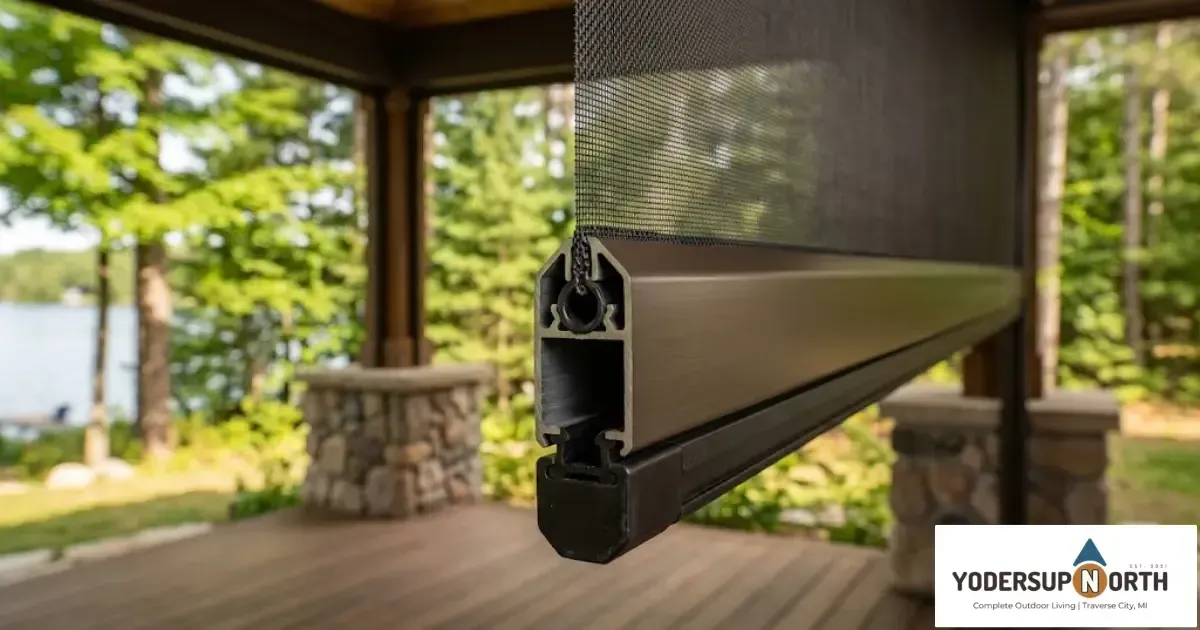
OneTrack addresses this with brute, deliberate engineering at the bottom of the screen. Its weight bar is, pound for pound, the heaviest and most robust in the industry — made from high-strength nylon with reinforced corners and integrated tie-ins, so the deployed screen behaves less like a hanging sheet and more like a solid wall. That mass and rigidity hold proper tension and keep the screen flat and stable when the wind comes off the bay. Combined with the locked-in keder edge, it's why the system is rated to withstand winds up to 100 mph — the same engineering Fenetex uses in its hurricane-rated screens. A bay breeze that would billow a cheap screen barely moves a OneTrack.
There's a wear detail here worth noting, because it shows the level the engineering works at: the highest-wear point on any retractable screen is the corner where the weight bar meets the screen edge. OneTrack reinforces exactly that spot with a toughened nylon guide, specifically to extend the screen's life where it would otherwise fray first.
What a Lifetime Warranty Actually Tells You
Warranties are a useful tell. A company warranties the things it isn't afraid of, and it writes the fine print carefully around the things it is. So it's worth noting that OneTrack puts a lifetime warranty on the welded keder edge — the precise component that is the most common failure point across the whole category — and offers warranty coverage across the motor, frame, and fabric as well. Read that as a signal: the manufacturer is most confident exactly where cheaper products are weakest.
We'll always walk you through the specific warranty terms by component before you buy — what's covered, for how long, and by whom — because that's part of buying honestly. But the headline is simple enough: the engineering and the warranty point the same direction.
Why This Matters More in Northern Michigan
Two of these four failure modes are amplified by exactly where we live. The freeze-thaw cycles that move structures are more aggressive here than in the warm-climate markets where retractable screens were first popularized, which makes the self-adjusting track genuinely valuable rather than a nice-to-have. And the wind off the open water is real, which makes the heavy weight bar and the locked keder edge earn their keep.
There's also the service-call problem, which is less about engineering and more about who's standing behind it. Even the best system occasionally needs attention, and the difference between a fifteen-minute response and a three-hour drive is the difference between a minor errand and a ruined week. A system engineered for 99% fewer service calls, installed and serviced by a local team that's actually nearby, is a fundamentally different ownership experience than a cheap screen supported from the other side of the state. That combination — the right engineering plus local accountability — is what we're really offering.
The short version: motorized screens fail at four predictable points — the zipper edge, the overworked motor, the structure that settles, and the wind. Fenetex OneTrack is engineered against all four: a welded keder edge with no zippers (lifetime warranty), a spring-balanced Quiet Spring motor that only starts and stops the screen (99% fewer service calls), a self-adjusting track that compensates for structural movement, and the industry's heaviest weight bar holding it flat in winds rated to 100 mph. Those failure modes are sharper in Northern Michigan, which is exactly why YODERSUPNORTH installs OneTrack and services it locally.
Frequently Asked Questions
Why do most motorized screens fail?
Lower-tier motorized screens typically fail at four points within five to ten years. The zipper or cable that retains the screen edge snags, separates, and gaps. The motor burns out from lifting the screen's full weight on every cycle. The screen binds or gaps as the structure settles and shifts over time. And a light weight bar lets wind flex and billow the screen until it tears loose or wears out. Each is an engineering shortcut, and each is avoidable with a system designed against it.
How long do OneTrack motorized screens last?
OneTrack is engineered specifically against the failure modes that end cheaper screens early, which is why the manufacturer credits the design with 99% fewer service calls over its operating life. The welded keder edge — the component that fails first in most systems — is backed by a lifetime warranty, with additional coverage on the motor, frame, and fabric. With a properly engineered system installed correctly, a homeowner should expect many years of reliable service rather than a replacement conversation a half-decade in.
Are motorized screens noisy?
Cheaper systems often are — a grinding, clanging deployment from a motor straining against the screen's weight. OneTrack is built differently. Its Quiet Spring technology uses a spring to carry the screen's weight, so the motor only starts and stops the screen rather than lifting it, and it deploys nearly silently. The engineers compare it to shock absorbers in a car: it's the springs that give you the quiet, smooth ride. On a still evening, that near-silence is a meaningful part of the experience.
What happens when my deck or pergola settles over time?
This is exactly the problem OneTrack's self-adjusting track was designed to solve. Every structure shifts and settles over the years, and Northern Michigan's freeze-thaw cycles accelerate it. A fixed-tension screen would bind or gap and need re-tensioning service calls; OneTrack's track automatically compensates for that movement, keeping the screen sealing and operating smoothly without manual adjustment. It was the first quiet self-adjusting screen system on the market, and that feature matters more in our climate than almost anywhere else.
Can OneTrack screens really handle wind off the bay?
Yes. OneTrack screens are rated to withstand winds up to 100 mph — the same engineering Fenetex uses in its hurricane-rated systems — so a Northern Michigan bay breeze is well within range. Two design elements do the work: the welded keder edge keeps the screen locked into its tracks, and the weight bar (the heaviest in the industry, with reinforced nylon corners) holds the screen flat and taut so wind can't billow or flex it. Deployed, it behaves more like a solid wall than a hanging sheet.