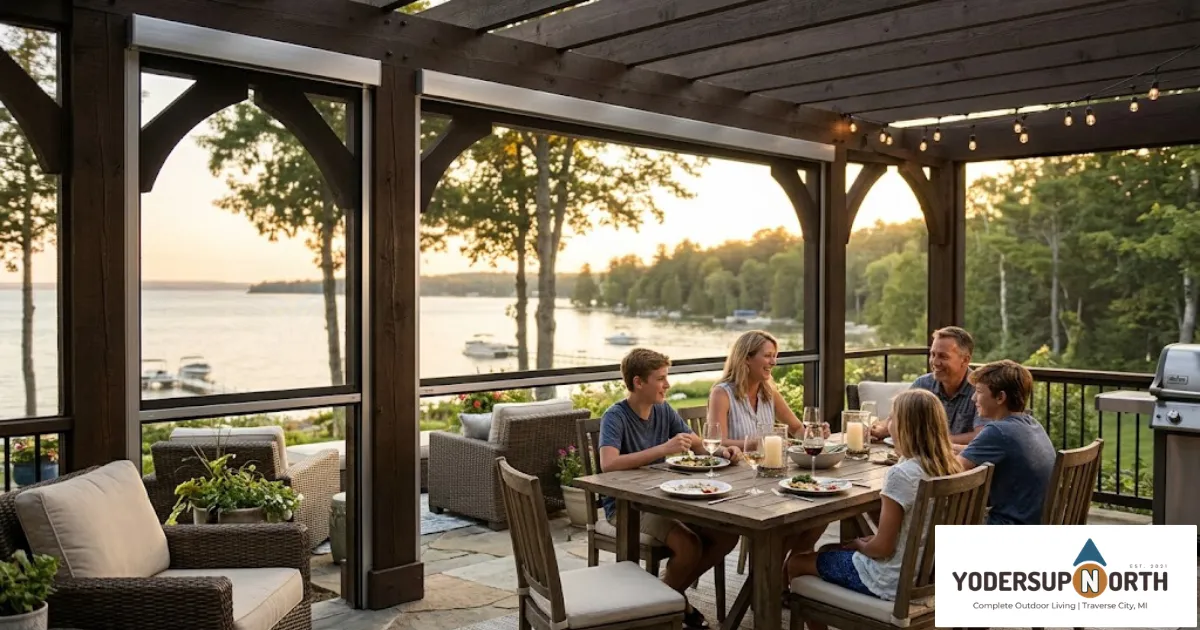
Why Northern Michigan's Best Outdoor Spaces Sit Empty Half the Year
There is a particular kind of frustration that belongs to people who own beautiful outdoor spaces in Northern Michigan.
You built the deck, or you bought the home for the view of the bay, or you finally finished the patio you'd been picturing for years. And for a few perfect weeks, it is everything you hoped. Then the season turns the way it always does up here. The mosquitoes arrive in June. The no-see-ums come off the water at dusk, when the light is best and you most want to be outside. A clear afternoon flips to a cold wind off Grand Traverse Bay in the time it takes to refill a drink. And slowly, without ever quite deciding to, the family drifts back indoors for the evening — through the most beautiful months of the year, in the space that cost the most to build.
This is the Northern Michigan paradox. The warm season is short and precious — and a remarkable amount of it gets surrendered to bugs, wind, and weather that nobody planned around because there didn't seem to be anything to do about them. The space sits empty not because it isn't good, but because it isn't comfortable at the exact hours it should be best.
This is the first installment of Built for the North, a twelve-part series on building outdoor living that actually survives — and gets used — in a climate that's hard on everything. We're starting here, with the problem most homeowners have quietly accepted, because there is a well-engineered answer to it that most people in this market have simply never seen.
Quick Answer
What are motorized screens, and why are Northern Michigan homeowners installing them?
Motorized retractable screens are engineered fabric screens that deploy at the press of a button to enclose a patio, porch, or covered outdoor room — sealing out insects, blocking wind and light rain, and cutting sun and glare — then retract completely out of sight when you want open air again. Yoders Up North installs the Fenetex OneTrack system, which stays locked in its track in high wind, self-adjusts as a structure settles over the seasons, and carries a lifetime warranty. Northern Michigan homeowners install them for one reason above all others: the region's warm season is too short to lose half of it to bugs and weather. A screen system turns an outdoor space that gets used for a handful of perfect evenings into one that gets used from the first warm days of spring through the last golden evenings of fall — bug-free, weather-protected, and on the homeowner's terms.
The Real Cost of a Short Season
Northern Michigan's building season runs, generously, from May through October. The truly comfortable outdoor-living window is shorter than that — and it gets shorter still once you subtract the evenings lost to insects and the afternoons cut short by weather coming off the water. For a region where people pay a real premium to live near the lakes and the bay, that's a strange arithmetic: enormous value placed on the outdoors, and a surprisingly small fraction of the year actually spent in it comfortably.
The bug pressure here is specific and worth naming. Mosquitoes are the obvious culprit, but the harder problem near the water is the no-see-um — the tiny biting midge that comes off lakes and wetlands at dusk and slips through ordinary screen mesh as if it weren't there. Black flies take the late spring. Together they own exactly the hours homeowners most want: the long golden evenings from June through September when the light is best and the air finally cools.
Most households respond the way most households do. Citronella candles. The plug-in foggers. The bottles of spray by the door. A standing fan aimed across the table. None of it really works, and all of it adds up — quietly, year after year — to a meaningful annual spend on temporary fixes that don't fix anything. The evening still ends with everyone inside.
And then there's the weather. A patio on an exposed lot — and many of the best lots up here are exposed, because that's where the views are — is at the mercy of wind off the bay and the sudden light rain that blows through on a summer afternoon. The space becomes unpredictable, and unpredictable spaces don't get used. People stop planning the dinner outside because they can't count on it. The outdoor room becomes a fair-weather room, available only on the afternoons it happens to cooperate.
What a Motorized Screen Actually Is — and Isn't
"Screens" is a word that carries some baggage, so it's worth being precise about what we're describing, because it isn't any of the three things most people picture first.
It isn't a screened-in porch.
A screened porch is permanent construction — a fixed roof, fixed walls, fixed screen panels you can never move. It commits the space to one state forever: always enclosed, always shaded a little, always between you and the open air. A motorized screen does the opposite. The default state is open. You have a true open-air patio whenever you want one, and the enclosure appears only when you call for it, then disappears again. You're not giving up the openness to gain the protection; you're getting both, on demand.
It isn't a roll-down patio shade.
The inexpensive roll-up screens and shades sold at big-box stores share a category name with engineered motorized screens and almost nothing else. The cheap versions are held shut with zippers that snag, cables that stretch, and edges that gap — which is exactly why a no-see-um finds its way in and why the whole assembly tends to fail within a few seasons. The difference between that and an engineered system is the difference between a tarp and a roof.
It is an engineered system that disappears when you don't need it.
A motorized retractable screen is a fabric screen wound on a tube inside a slim aluminum housing, riding in side tracks, driven up and down by a quiet motor. Deployed, it forms a sealed wall of screen across an opening — locked into the tracks edge to edge so insects can't get around it and wind can't tear it loose. Retracted, it rolls back up into its housing and the opening is simply open again. The good systems are nearly silent, and when they're closed you mostly forget they're there; you just notice that the bugs are gone and the wind has stopped.
The Three Problems Screens Solve Up Here
Insects — the obvious one
This is what most people come for, and it's the most complete win. With a sealed screen across the opening, the evening stops belonging to the mosquitoes. For properties near the water, the system can be specified with a finer no-see-um mesh that closes the gap the midges exploit. The candles and sprays go in a drawer and stay there. Dinner runs long, the kids stay out, and nobody is slapping at their ankles.
Wind and weather off the bay
Beyond bugs, a deployed screen takes the edge off the wind and turns back the light rain that would otherwise drive everyone inside. The exposed lot with the best view becomes usable on the afternoons it used to lose to a gusty breeze. The space stops being a fair-weather room. You can plan the dinner and trust that it will happen.
Privacy without feeling walled in
On lots where the neighbors are close, a privacy or solar mesh lets you screen the space when you want to feel unobserved, then open it back up to the view when you don't. It's privacy you control by the hour rather than a fence you commit to forever — autonomy over the space, not a wall around it.
Why Yoders Installs OneTrack
Most motorized screens that get installed in cottage country fail within five to ten years, and they fail for boring, predictable reasons: zippers snag, cables stretch, tracks shift as the structure moves, motors strain against the weight of the screen until they give out. What starts as a premium upgrade turns into a string of service calls. We install the Fenetex OneTrack system because it was engineered specifically against those failure modes — which matters more here than in the warm-climate markets where retractable screens were first popularized, because a Northern Michigan structure lives through brutal freeze-thaw cycles and 145 inches of snow in a season, and it moves.
A few pieces of that engineering are worth understanding, because they're the reason the system lasts:
Quiet Spring technology
OneTrack uses a spring-balanced motor. The spring counterweights the screen, so the motor's only job is to start and stop the screen — not to lift its full weight every time. That's the difference between a motor that's working hard against gravity on every cycle and one that's barely loaded. It's the single biggest reason the system runs quietly and racks up far fewer service calls over its life than the products that strain their motors from day one.
A self-adjusting track
Wood, aluminum, and composite structures all settle and move with the seasons — and in a climate like ours they move a lot. OneTrack's track system compensates for that natural movement, so the screen keeps sealing properly through years of thermal expansion and structural settling rather than gapping the first time the deck shifts. A smart motor also senses resistance and self-corrects around an obstacle instead of jamming. Fewer snags, fewer jams, fewer calls.
Keder-edge retention and a heavy weight bar
Instead of zippers, cables, and exposed hardware, OneTrack uses a keder edge — a technique borrowed from sailboat rigging — to lock the screen fabric into the track. That's what keeps it sealed edge to edge and keeps it from tearing loose in a strong bay wind; the system stays locked in the track even in high wind, and it's rated to 100 mph. A heavy, robust weight bar at the bottom holds proper tension so the screen deploys flat and stable rather than billowing. The whole system is backed by a lifetime warranty.
One button — and smart-home control if you want it
At its simplest, the system is a button on the wall or a remote. If you want more, it integrates with your phone, with voice assistants, and with home automation, so the screens can come down on a schedule, on a weather trigger, or with a word from across the yard. We'll talk through the right level of automation for how your household actually lives — most people are happy with the simple version, and that's a perfectly good answer.
What This Means for Your Season
Here's the change worth picturing. Right now, the comfortable outdoor evenings probably number in the dozens — the handful of nights when the bugs are light and the wind is calm and the timing happens to work out. With a screen system, that's not the ceiling anymore. The space becomes usable on the evenings it used to lose, which in this region is most of them, from the first warm days of spring through the last golden evenings of fall.
For a household that chose this place partly for the outdoors, that's the whole point. It isn't really a screen purchase. It's buying back the months of the year the bugs and the weather had been quietly taking — in the space you already own, that you already love, that's simply been waiting to be comfortable at the right hours.
What This Series Covers Next
Built for the North runs twelve installments across the season, each one looking at a different piece of building outdoor living that lasts in this climate. Over the coming weeks we'll get into why composite decking outlasts wood through Michigan winters, how an adjustable louvered roof gives you total control over sun and rain, why most motorized screens fail and how the engineered ones don't, what these projects actually cost up here, and how the pieces — deck, pergola, pavilion, roof, screens — fit together into one outdoor space that gets used spring to fall.
If you've read this far, you already know the problem from your own back patio. The rest of the series is about the answers.
The short version: Northern Michigan's outdoor season is too valuable to surrender half of it to bugs and weather. A Fenetex OneTrack motorized screen system, installed by Yoders Up North, seals out insects, turns back wind and light rain, and gives you privacy on demand — then retracts out of sight when you want open air. Engineered for a climate that's hard on everything, backed by a lifetime warranty, and built to give you back the months you'd been losing.
Frequently Asked Questions
Do motorized screens really keep out no-see-ums and the small lake bugs?
Yes, with the right mesh. OneTrack screens lock into their tracks edge to edge, so there's no gap at the sides for an insect to slip through — that sealed edge is the part cheaper screens get wrong. For properties near lakes and wetlands where no-see-ums are the real problem, we specify a finer no-see-um mesh rather than standard insect mesh. We'll recommend the mesh based on your specific location and what's biting there.
Can the screens handle Northern Michigan wind and snow?
The OneTrack system is rated to 100 mph winds and stays locked in its track in strong gusts, so a normal bay breeze is well within its range. Screens are deployed on demand and retracted into their housings when not in use, so they're not left exposed to winter snow load the way a fixed enclosure would be — you simply retract them for the season. The track system is also engineered to keep sealing as the structure settles and moves through freeze-thaw cycles.
What openings can be screened — only existing porches?
Not at all. The screens can enclose an existing covered patio or porch, the openings of a pergola or pavilion, or a new outdoor structure designed for them from the start. Because Yoders builds the decks, pergolas, pavilions, and louvered roofs as well, we can plan the structure and the screens together so the system integrates cleanly rather than being added on afterward. The free consultation includes assessing which openings make sense for your space.
How much do motorized screens cost in the Traverse City area?
As a general range, individual openings in the Traverse City area typically run from around $3,000 to $8,000 and up depending on size, mesh type, and automation level, and full multi-opening patio enclosures generally fall between roughly $12,000 and $30,000 and up. Where a specific project lands depends on the number and size of openings and the options chosen. A later piece in this series breaks the pricing down in detail; for now, a free consultation produces a specific quote for your property.
Who installs OneTrack screens in Northern Michigan?
Yoders Up North is a certified Fenetex dealer serving Traverse City and the surrounding 30-to-50-mile area — Old Mission, Leelanau, Torch Lake, and the bayfront communities. We're a family-operated builder with more than twenty years of construction experience and Amish craftsmanship roots, which means the same people who design your space install the system and stand behind it. There is very little local competition for engineered motorized screen installation up here, and local service — being fifteen minutes away rather than three hours — matters a great deal when it's time for adjustments or seasonal help.